
Why operationalization is the missing layer in growth.
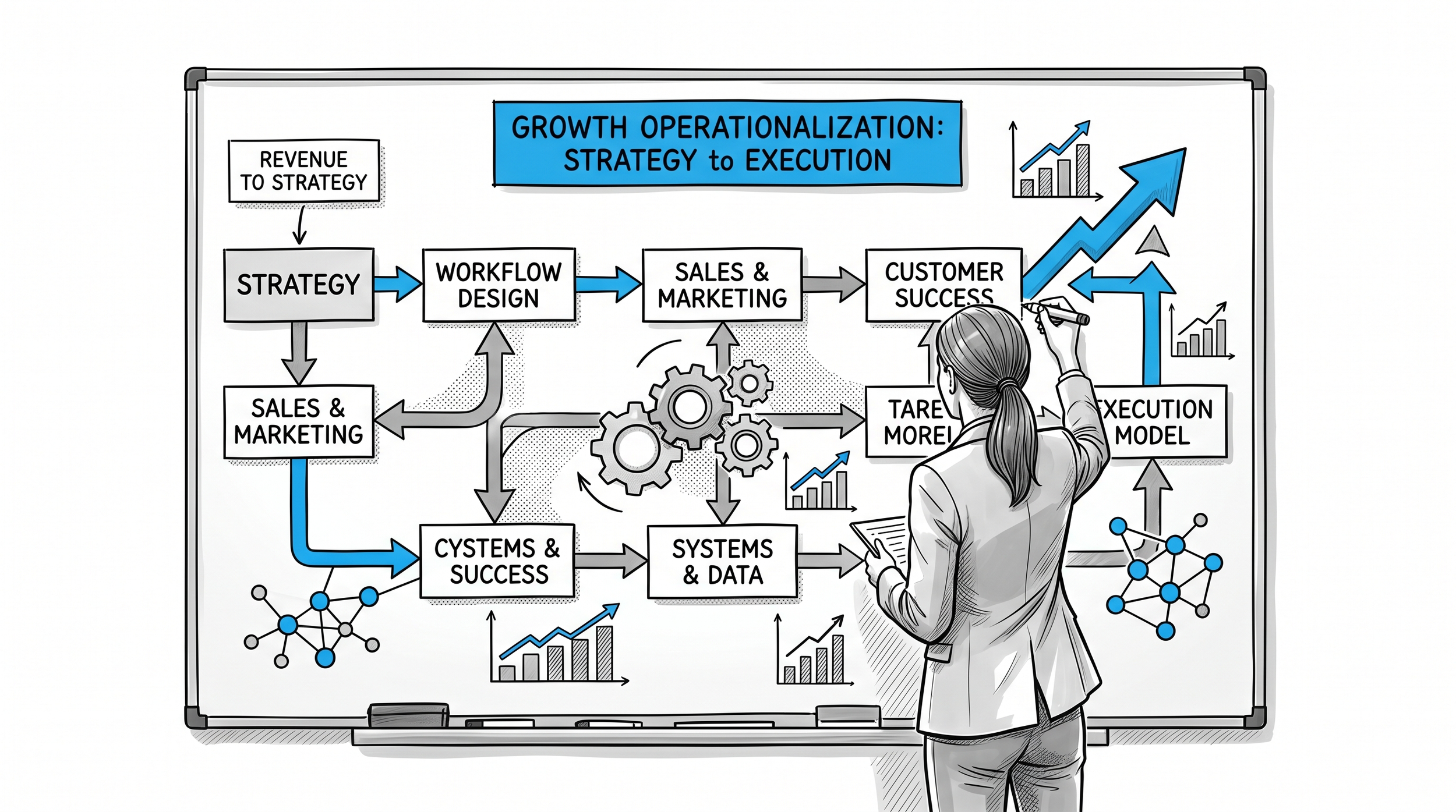
Most growing organizations do not struggle because they lack ideas.
They struggle because the business becomes more complex than the operating system behind it.
The strategy is clear. The market opportunity exists. The team is capable. The problem is that execution starts depending too heavily on memory, meetings, individual heroics, side-channel communication, and informal workarounds.
That is where growth begins to drag.
The missing layer is operationalization.
Operationalization is the work of turning strategy into repeatable execution. It connects people, workflows, systems, customer experience, GTM execution, and leadership visibility into a practical operating rhythm.
Without it, growth creates more activity without creating more clarity.
Growth Creates Operational Complexity
Early-stage and growth-stage companies often build momentum through urgency, talent, and direct communication. That works for a while.
A founder can clarify priorities in real time. A sales leader can jump into deals. A customer success lead can personally manage escalations. A few people can hold the operating model in their heads.
Then the company grows.
More customers. More offers. More sales motion. More handoffs. More systems. More internal meetings. More dashboards. More process documents. More people asking different versions of the same question.
At that point, the issue is rarely effort.
The issue is operational complexity.
The business has outgrown the informal systems that helped it get traction.
The Strategy-to-Execution Gap
Many companies respond to growth friction by adding more strategy.
A new plan. A new initiative. A new dashboard. A new meeting. A new tool. A new campaign. A new AI experiment.
Some of those may be useful. Many of them add more noise when the operating layer is weak.
The real gap usually sits between strategy and execution.
That gap shows up in practical ways:
Teams interpret priorities differently.
Sales and delivery define success differently.
CRM data becomes unreliable.
Customer handoffs depend on individual follow-up.
Reporting shows activity but not operational risk.
Leaders cannot see where execution is actually stuck.
AI initiatives stall because workflows and ownership are unclear.
The company may still be growing, but growth starts carrying more drag than it should.
That is the cost of weak operationalization.
What Operationalization Actually Means
Operationalization is not bureaucracy.
It is the discipline of making work executable, visible, and repeatable.
For a growing B2B organization, that usually includes:
Clear ownership across teams
Defined workflows and handoffs
Systems that match how the business actually runs
CRM and data governance that people can follow
Customer lifecycle visibility
Operating cadences that support decisions
Practical enablement for adoption
Metrics that show execution health, not just activity
Workflow maturity that prepares the organization for AI-enabled execution
Operationalization turns the business from a collection of moving parts into a coordinated operating system.
It gives teams a shared way to execute.
The Signs Operationalization Is Missing
Operationalization problems are easy to misdiagnose.
They often get labeled as sales problems, marketing problems, CRM problems, customer success problems, or people problems.
Sometimes those labels are accurate. Often, they are symptoms.
Here are the common signs that the operating layer needs work.
1. Execution drag
The business is moving, but everything takes too much effort.
Decisions require too many meetings. Handoffs require follow-up. Leaders have to intervene too often. Teams feel busy, but momentum is uneven.
2. Workflow fragmentation
Different teams create their own ways of working.
Marketing, sales, customer success, finance, and operations may all be trying to support the same growth goals, but their workflows are not connected cleanly.
The result is rework, confusion, and inconsistent execution.
3. CRM inconsistency
The CRM becomes a reflection of process inconsistency.
Fields are incomplete. Stages mean different things to different people. Forecasting depends on manual interpretation. Leaders question the data because the operating discipline behind the system is weak.
The tool is rarely the whole problem. The workflow around the tool is usually the issue.
4. Visibility gaps
Leadership has reports, but not always visibility.
Dashboards may show pipeline, revenue, tasks, activity, or customer status. That does not mean leaders can clearly see execution risk, ownership gaps, customer friction, or workflow breakdowns.
Operational visibility requires clear process design before reporting can become useful.
5. AI readiness confusion
Many companies want AI to improve speed, efficiency, and customer experience.
The problem is that AI performs best when workflows, data, ownership, and decision logic are already clear.
If the operating model is fragmented, AI often accelerates confusion instead of improving execution.
AI readiness starts with operational maturity.
Why This Matters More Now
Growth-stage B2B organizations are under pressure to move faster, operate leaner, improve customer experience, and adopt AI without creating more complexity.
That puts more strain on the operating layer.
The companies that scale well are not simply the ones with the best strategy. They are the ones that can turn strategy into coordinated execution across teams and systems.
That requires more than planning.
It requires operational architecture.
It requires the ability to connect product, GTM, customer operations, finance, and leadership visibility into one execution model.
This is where operationalization becomes a growth advantage.
What Good Operationalization Looks Like
When operationalization is working, the organization feels different.
Teams know what they own.
Handoffs are clear.
CRM data is more reliable because the workflow behind it is more disciplined.
Customer onboarding and delivery become more consistent.
Leadership can see where execution is on track, where risk is building, and where intervention is needed.
AI and automation opportunities become easier to identify because the underlying workflows are visible and structured.
The business stops relying on constant manual coordination.
That is when growth becomes more scalable.
Where to Start
Operationalization does not have to begin with a large transformation initiative.
In many organizations, the best starting point is a focused diagnostic around where execution is breaking down.
Start with these questions:
Where are teams relying on workarounds?
Which handoffs create the most confusion?
Where does CRM or operational data lose reliability?
What does leadership need to see but cannot easily access?
Which workflows would need to be cleaned up before AI could be useful?
Where does customer experience depend too heavily on individual effort?
What parts of the business are growing faster than the systems supporting them?
The answers usually point to the real work.
That work may include workflow architecture, CRM operationalization, customer lifecycle systems, process governance, operating cadence design, dashboard structure, or AI readiness planning.
The important part is sequencing.
Do not start with the tool. Start with the operating reality.
Operationalization Is the Layer Behind Scalable Growth
Growth creates pressure.
Operationalization creates the structure to handle it.
For B2B organizations, the next stage of growth often depends on whether the business can create the systems, workflows, visibility, and operating discipline needed to execute consistently.
That is the missing layer.
It is the layer between product and revenue.
Between strategy and execution.
Between customer expectations and internal delivery.
Between AI ambition and workflow maturity.
Between leadership priorities and daily operating behavior.
Operationalization is where growth becomes executable.
If your organization is growing but execution feels fragmented, Uplida can help identify where the operating layer needs to be strengthened.
Schedule a consultation to discuss where growth is getting stuck.
