
AI Readiness Starts With Operational Maturity
AI is moving quickly.
Most organizations know they need to pay attention. Many are already experimenting with automation, AI assistants, workflow tools, customer support bots, content generation, reporting automation, and internal productivity use cases.
The problem is not interest.
The problem is readiness.
AI does not magically fix operational confusion. It does not solve unclear ownership. It does not clean up inconsistent workflows. It does not make unreliable data trustworthy. It does not create decision logic where none exists.
AI performs best when the operating environment around it is mature enough to support it.
That is why AI readiness starts with operational maturity.
AI Does Not Replace the Operating System
Many organizations approach AI as a technology initiative.
They ask:
What tools should we use?
What can we automate?
Where can we save time?
How do we use AI in sales, service, marketing, or operations?
What should we pilot first?
Those are valid questions.
They are not the first questions.
The better starting point is:
Is the work clear enough to be automated, assisted, or improved?
If the workflow is unclear, AI will inherit that confusion.
If ownership is unclear, AI will expose it.
If customer data is inconsistent, AI will work from a weak foundation.
If teams already use different definitions, processes, and workarounds, AI can accelerate fragmentation instead of reducing it.
AI is not a substitute for operational discipline.
It is a layer that depends on it.
Operational Maturity Comes Before Automation
Operational maturity means the organization has enough clarity, consistency, and visibility to execute reliably.
That does not mean everything is rigid or over-processed.
It means the business has a clear enough operating foundation:
Teams know who owns what.
Workflows are defined.
Handoffs are consistent.
Systems reflect how the business actually runs.
Data is usable and governed.
Leaders can see where execution is on track or at risk.
Process adoption is strong enough to trust the system.
Decision logic is clear enough to support automation.
This is the foundation AI needs.
Without it, AI projects often become isolated experiments. A chatbot here. A content tool there. A workflow automation that helps one team but creates confusion for another.
The organization may look more advanced, but the operating model has not improved.
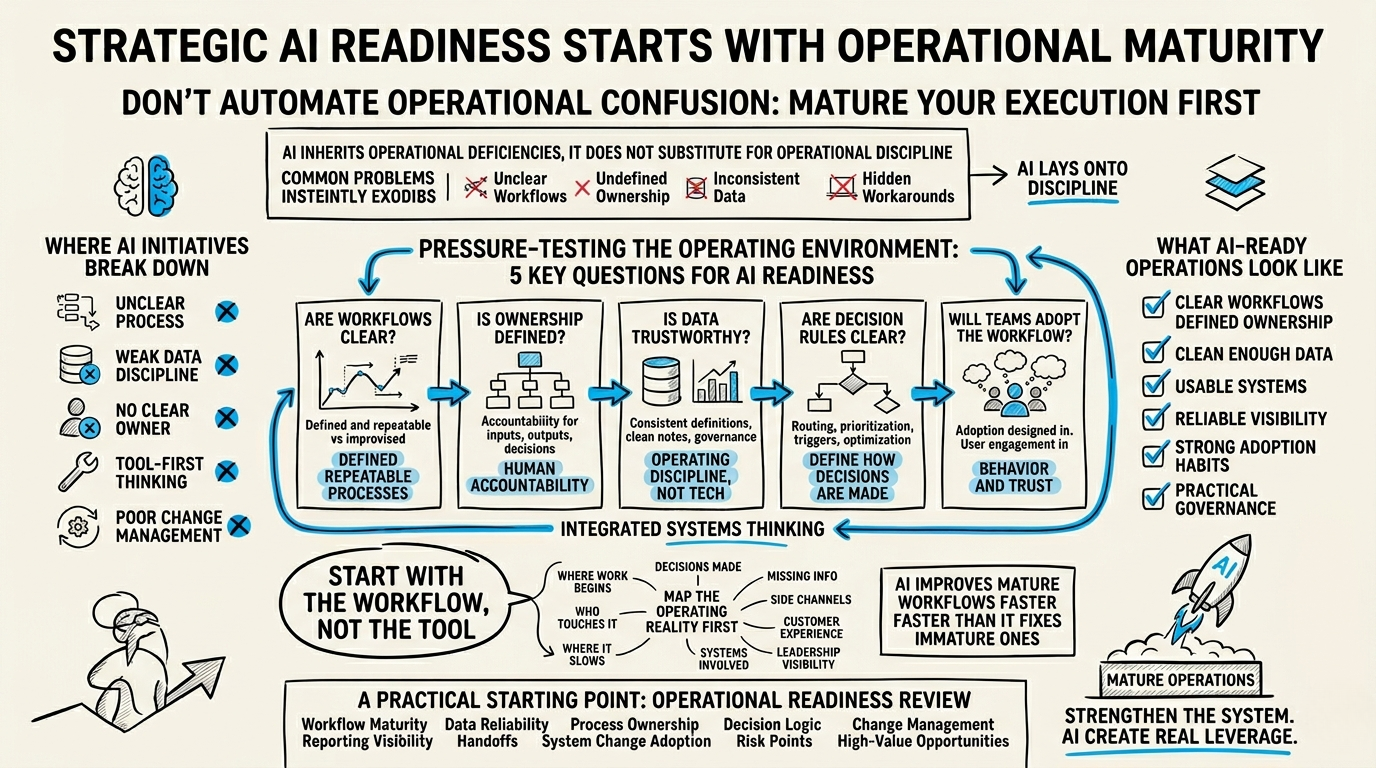
The Real AI Readiness Questions
Before investing heavily in AI tools, organizations should pressure-test the operating environment.
Start with these questions:
1. Are the workflows clear?
AI can support repeatable work. It struggles when the work is undefined or constantly improvised.
If a team cannot clearly describe how a process works today, it is not ready for meaningful automation.
2. Is ownership defined?
AI-enabled workflows still need human accountability.
Someone must own the process, the inputs, the outputs, the escalation path, and the decision points.
Without ownership, automation creates ambiguity faster.
3. Is the data trustworthy?
AI is only as useful as the data and context available to it.
If CRM fields are inconsistent, customer notes are scattered, support categories are messy, or reporting definitions vary by team, AI outputs will be limited.
Data quality is not a technical issue alone. It is an operating discipline issue.
4. Are decision rules clear?
AI can assist with routing, prioritization, recommendations, summarization, and workflow triggers.
But first, the organization needs to define how decisions should be made.
If the business does not know what matters, AI cannot reliably optimize for it.
5. Will teams adopt the workflow?
AI readiness is not only about tooling. It is also about behavior.
A technically sound automation will fail if teams do not trust it, use it, or understand how it fits into the operating rhythm.
Adoption must be designed into the workflow from the beginning.
Where AI Readiness Breaks Down
AI initiatives usually break down in predictable places.
Unclear process
Teams want to automate a workflow that has never been fully defined.
The automation project reveals that different people follow different steps, use different definitions, or rely on informal judgment that has never been documented.
Weak data discipline
The company wants better AI-assisted reporting, forecasting, routing, or customer insights, but the source data is inconsistent.
The AI tool becomes the focus, when the real issue is governance.
No clear owner
Everyone agrees AI could help, but no one owns the underlying business process.
Without a process owner, the initiative drifts.
Tool-first thinking
The company starts with software selection instead of operational readiness.
This often leads to scattered pilots that do not connect to larger business execution.
Poor change management
The tool is launched, but the operating rhythm does not change.
Teams keep working the old way while the AI system sits around the edges.
AI Readiness Is Cross-Functional
AI readiness does not belong to one department.
It touches:
operations
revenue
marketing
sales
customer success
service delivery
finance
product
IT
leadership
That is why AI readiness is really an operational issue.
For example, a customer support AI initiative may require:
clean support categories
clear escalation rules
strong knowledge base structure
customer lifecycle visibility
ownership of response quality
reporting on resolution trends
adoption by customer-facing teams
alignment with revenue and retention goals
That is not just a technology project.
It is operational enablement.
The same is true for AI in GTM, CRM, forecasting, onboarding, content systems, internal reporting, or service delivery.
AI works best when cross-functional execution is already being managed intentionally.
What AI-Ready Operations Look Like
An AI-ready organization does not need to be perfect.
It does need a practical operating foundation.
You will usually see:
Clear workflows
The organization knows how key work moves from start to finish.
Defined ownership
Teams understand who owns each stage, decision, and outcome.
Clean enough data
Data does not have to be flawless, but it must be consistent enough to support decisions.
Usable systems
Systems reflect real workflows rather than wishful process maps.
Reliable visibility
Leaders can see execution health, not just disconnected activity.
Strong adoption habits
Teams follow the operating rhythm enough for AI to assist the work.
Practical governance
There are rules for how workflows change, how data is maintained, and how outputs are reviewed.
This is what makes AI useful.
Start With the Workflow, Not the Tool
The best AI readiness work starts by mapping the operating reality.
Not the ideal process.
The real one.
Where does work begin?
Who touches it?
Where does it slow down?
Which systems are involved?
What decisions are made?
What information is missing?
Where do teams rely on side channels?
Where does customer experience become inconsistent?
Where does leadership lose visibility?
That map reveals whether AI can help now, or whether the workflow needs to be cleaned up first.
In many cases, the first phase of AI readiness is not automation.
It is operational clarity.
AI Readiness Use Cases
Once the operating foundation is clear, AI can support real execution.
Examples include:
Customer operations
AI can help summarize customer history, support triage, recommend next steps, improve knowledge access, and identify risk patterns.
But only if customer data, service categories, escalation rules, and ownership are clear.
Revenue and CRM
AI can support sales follow-up, pipeline analysis, forecasting inputs, account research, and deal summaries.
But only if CRM discipline and stage definitions are reliable.
Marketing and enablement
AI can support content workflows, campaign operations, messaging consistency, and sales enablement materials.
But only if the content system, review process, and GTM priorities are structured.
Operational reporting
AI can help summarize metrics, detect patterns, and surface risks.
But only if the reporting logic is sound and the source data is trustworthy.
Internal workflows
AI can help reduce manual coordination, create summaries, route tasks, and support internal knowledge access.
But only if workflows and decision rules are defined.
The pattern is consistent:
AI improves mature workflows faster than it fixes immature ones.
The Leadership Opportunity
Leaders do not need to become AI experts overnight.
They do need to understand that AI readiness is an operating model question.
The leadership role is to ask:
Which workflows matter most?
Where is execution currently breaking down?
What data do we trust?
What decisions could be better supported?
What should remain human-owned?
Where would AI create the most leverage?
Where would AI create more risk because the process is immature?
The organizations that answer those questions clearly will adopt AI more effectively.
The ones that skip the operating work may spend money on tools without changing execution.
A Practical Starting Point
If your organization is considering AI adoption, start with an operational readiness review.
Look at:
Workflow maturity
Data reliability
Process ownership
System adoption
Reporting visibility
Customer and revenue handoffs
Decision logic
Change management capacity
Risk points
High-value automation opportunities
Then prioritize the areas where AI can improve execution without creating unnecessary complexity.
The goal is not to automate everything.
The goal is to strengthen the operating system so AI can create real leverage.
AI Readiness Is an Execution Discipline
AI can help organizations move faster.
But speed without operational maturity creates noise.
The real advantage comes when AI is layered onto clear workflows, reliable systems, strong ownership, trusted data, and practical governance.
That is when automation becomes useful.
That is when AI supports execution instead of distracting from it.
That is when technology starts improving how the business actually runs.
AI readiness starts with operational maturity because mature operations give AI something solid to work with.
If your organization is exploring AI but the workflows, data, ownership, or operating rhythm are not yet clear, Uplida can help identify where readiness work needs to begin.
Schedule a consultation to assess your AI operational readiness.
