
The Execution Gap Between Product and Revenue
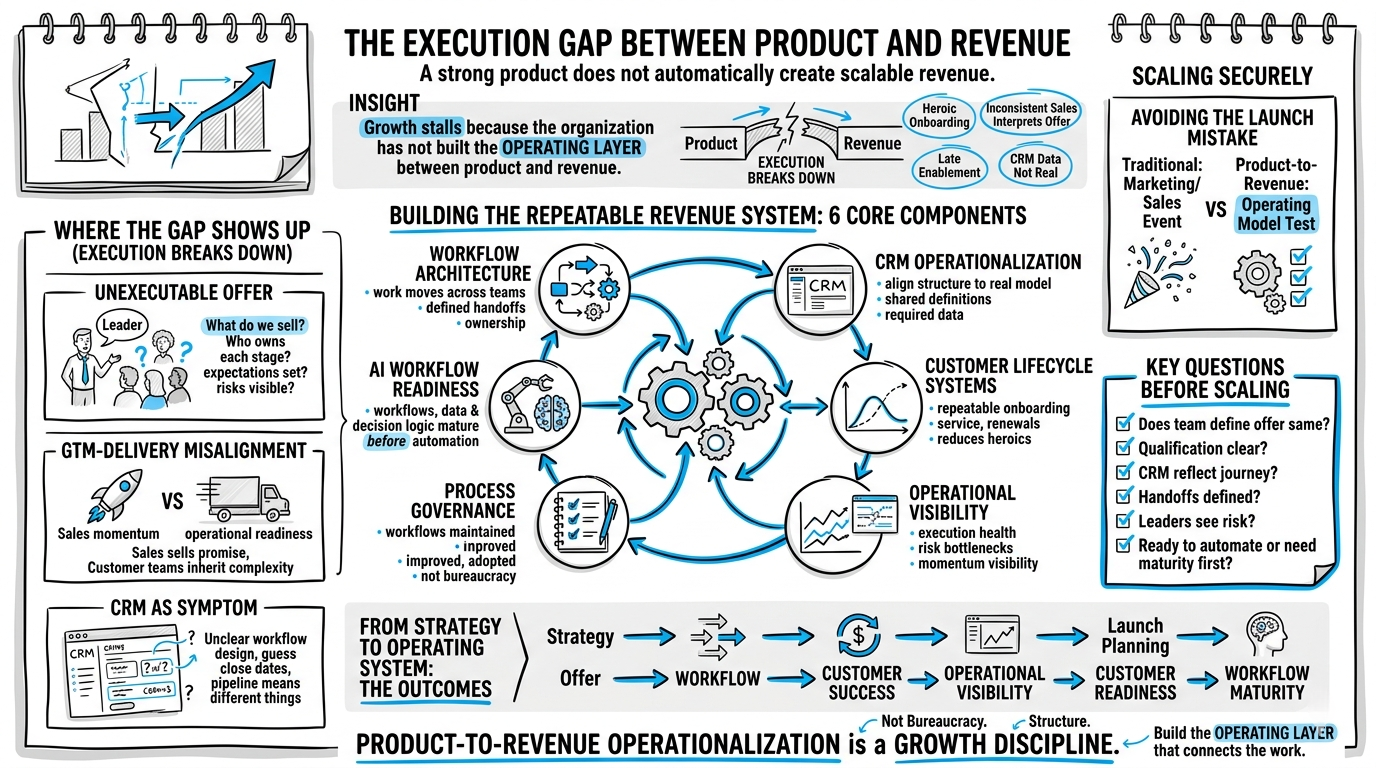
A strong product does not automatically create scalable revenue.
That is one of the most expensive assumptions inside growing B2B organizations.
The product may solve a real problem. The market may be clearly defined. The sales team may be capable. The customer need may be valid. Still, growth can stall because the organization has not built the operating layer between product and revenue.
That gap is where execution breaks down.
It shows up in launches that feel harder than they should. Sales teams that interpret the offer differently. CRM data that does not reflect reality. Customer onboarding that depends on individual heroics. Enablement that arrives too late. Leaders who cannot clearly see where momentum is slowing.
The problem is rarely one function.
It is the connection between functions.
That is the execution gap between product and revenue.
The Gap Is Not Just a Sales Problem
When revenue does not scale the way leadership expects, the first instinct is often to look at sales.
Is the team selling enough?
Is the pipeline strong enough?
Is the messaging clear?
Are the reps following the process?
Is the CRM being used correctly?
Those questions matter.
But many product-to-revenue problems are not sales problems alone.
They are operationalization problems.
The organization has not fully translated the product, offer, service model, customer promise, enablement, workflow, and reporting logic into a repeatable revenue system.
Sales is left to interpret the offer.
Customer success is left to clean up expectation gaps.
Operations is left to make delivery work.
Finance is left trying to understand margin, timing, and performance after the fact.
Leadership is left trying to manage growth through partial visibility.
The product may be good. The GTM effort may be active. But the system connecting them is weak.
Product-to-Revenue Requires an Operating Layer
Product-to-revenue operationalization is the work of connecting the full path from offer to revenue to customer experience.
That path usually includes:
Product definition
Market positioning
GTM workflow
Sales process
CRM structure
Pricing and packaging logic
Enablement
Customer onboarding
Service delivery
Support and escalation
Renewal or expansion motion
Operational reporting
Financial visibility
If those pieces are not connected, the customer experience becomes inconsistent and internal execution becomes harder to manage.
The business may still generate revenue, but it does so with friction.
Every deal requires too much coordination. Every handoff carries risk. Every customer implementation depends on who is involved. Every report needs interpretation. Every launch recreates the same confusion.
This is why product-to-revenue work cannot stop at messaging or sales enablement.
The offer has to be operationalized.
Where the Execution Gap Shows Up
The execution gap usually appears in practical, visible ways.
1. The offer is clear to leadership but not executable for teams
Leadership may understand the strategy, but teams need more than strategic intent.
They need to know:
What exactly are we selling?
Who owns each stage of the customer journey?
What qualifies as a good-fit customer?
What expectations are being set during the sales process?
What happens after the deal closes?
What data must be captured?
What risks need to be visible early?
Without that clarity, teams make their own interpretations.
That creates inconsistency.
2. GTM motion and customer delivery are not aligned
A common breakdown happens when sales momentum outpaces operational readiness.
Sales sells the promise.
Customer teams inherit the complexity.
Operations fills the gaps.
Finance sees the downstream impact.
Leadership hears about the problem after it becomes urgent.
This is not a people issue.
It is a handoff and operating model issue.
A strong product-to-revenue system defines how customers move from interest to purchase to onboarding to value realization. That system needs shared ownership across GTM, customer operations, service, finance, and leadership.
3. CRM does not reflect the real operating model
CRM problems are often symptoms of unclear workflow design.
If teams do not share definitions, ownership, stages, required fields, and process expectations, the CRM becomes unreliable.
Pipeline stages mean different things.
Close dates become guesses.
Handoffs happen outside the system.
Customer risk is tracked informally.
Forecasting depends on manual interpretation.
The issue is not just whether people are “using the CRM.”
The issue is whether the CRM has been operationalized around how the business actually runs.
4. Enablement becomes content instead of operating support
Many teams treat enablement as documents, decks, templates, or training sessions.
Those assets can be useful, but they are not enough.
True enablement helps teams execute consistently.
That means enablement should clarify:
What the offer means
How to position it
How to qualify opportunities
How to set expectations
How to use the system
How to move the customer through the lifecycle
How to identify risk
How to escalate
How success is measured
Enablement is not just information.
It is execution support.
5. Leaders cannot see where revenue execution is breaking down
Most organizations have reporting.
Fewer have operational visibility.
Revenue reports may show pipeline, bookings, activity, or conversion. Those metrics matter, but they may not show where execution is actually stuck.
Leaders need to see:
Where handoffs are slowing down
Where customer readiness is weak
Where CRM discipline is breaking
Where onboarding is inconsistent
Where delivery risk is growing
Where margin pressure is emerging
Where GTM activity is not translating into customer value
Without that visibility, leadership manages symptoms instead of the operating system.
Why This Gap Gets Bigger as Companies Scale
Small teams can operate through proximity.
People talk often. Leaders are involved in details. Exceptions are handled quickly. Everyone knows the customer, the offer, and the work.
That does not scale forever.
As the organization grows, informal coordination starts to break down.
More people are involved. More customers are moving through the lifecycle. More tools are introduced. More handoffs are required. More decisions happen without the founder or senior leader in the room.
At that stage, execution needs structure.
Not bureaucracy. Structure.
The company needs workflows, ownership, governance, visibility, and operating rhythms that allow teams to execute without constant manual intervention.
That is the operational layer between product and revenue.
What Strong Product-to-Revenue Operationalization Looks Like
When the product-to-revenue system is working, the business feels different.
The product is not just defined. It is executable.
The GTM team understands the offer, the buyer, the qualification logic, and the handoff requirements.
The CRM reflects the real sales and customer workflow.
Customer operations knows what is coming, what was promised, and what needs to happen next.
Finance has better visibility into pricing, delivery impact, and performance.
Leadership can see momentum, risk, and execution gaps earlier.
Teams are not relying on constant side-channel coordination to move work forward.
That is the difference between selling a product and operationalizing revenue.
The Core Components of the Operating Layer
The operating layer between product and revenue usually includes six core components.
Workflow architecture
Define how work actually moves across teams.
This includes handoffs, ownership, decision points, escalation paths, and customer lifecycle movement.
CRM operationalization
Align CRM structure to the real operating model.
This includes stage definitions, required data, process governance, pipeline hygiene, forecasting workflows, and adoption habits.
Customer lifecycle systems
Create repeatable workflows for onboarding, service delivery, support, renewals, and expansion.
This reduces dependency on individual heroics and improves customer consistency.
Operational visibility
Build reporting that shows execution health, not just activity.
Dashboards should help leaders see risk, accountability, bottlenecks, and momentum.
Process governance
Define how workflows are maintained, improved, and adopted.
Without governance, process quality decays over time.
AI workflow readiness
Prepare workflows, data, ownership, and decision logic before automation.
AI becomes more useful when the operating layer is already clear.
The Mistake: Launch First, Operationalize Later
Many companies launch before the operating system is ready.
They move fast, which is understandable. But speed without operational readiness creates avoidable friction.
The most common mistake is treating product launch as a marketing or sales event instead of a cross-functional operating motion.
A launch is not just:
a campaign
a sales deck
a website update
a pricing sheet
an announcement
a training session
A launch is an operating model test.
It tests whether the organization can move a defined offer through the full customer lifecycle consistently.
If the workflows, handoffs, systems, and ownership are not ready, the launch will expose it.
Questions to Ask Before Scaling a Product-to-Revenue Motion
Before pushing harder on growth, leadership should pressure-test the operating layer.
Start with these questions:
Does every team define the offer the same way?
Are qualification criteria clear?
Does the CRM reflect the actual customer journey?
Are handoffs between sales, delivery, success, and finance defined?
Does customer onboarding match what was sold?
Can leaders see where deals or customers are at risk?
Are pricing, delivery, and margin impacts visible?
Are enablement materials tied to actual workflow execution?
Are teams relying on side channels to move work forward?
Is the organization ready to automate parts of the workflow, or does the workflow need maturity first?
The answers will usually reveal whether the issue is demand, sales performance, customer delivery, or operationalization.
Product-to-Revenue Is a Growth Discipline
The gap between product and revenue is not solved by one tool, one meeting, one campaign, or one dashboard.
It is solved by building an operating layer that connects the work.
That layer helps the business move from:
strategy to execution
offer to workflow
sales to customer success
CRM activity to operational visibility
launch planning to customer readiness
AI interest to workflow maturity
This is where growth becomes scalable.
Not because the company is doing more.
Because the company is operating with greater clarity.
Closing Thought
The execution gap between product and revenue is one of the most important growth constraints inside B2B organizations.
It is also one of the most fixable.
When teams align around shared workflows, clear ownership, reliable systems, customer lifecycle visibility, and operational discipline, revenue execution becomes less dependent on improvisation.
The organization can move faster because the work is clearer.
The customer experience improves because handoffs are stronger.
Leadership can make better decisions because visibility is more reliable.
Growth stops being held together by constant coordination and starts becoming part of the operating system.
That is the work of product-to-revenue operationalization.
If your organization has a strong offer but execution breaks down between product, GTM, customer operations, and visibility, Uplida can help identify where the operating layer needs to be strengthened.
Schedule a consultation to discuss where the product-to-revenue motion is getting stuck.
