
Why CRM Problems Are Usually Operating Model Problems
Most CRM issues do not begin inside the software. They begin in the way a company defines ownership, manages customer movement, and connects revenue activity to operational execution.
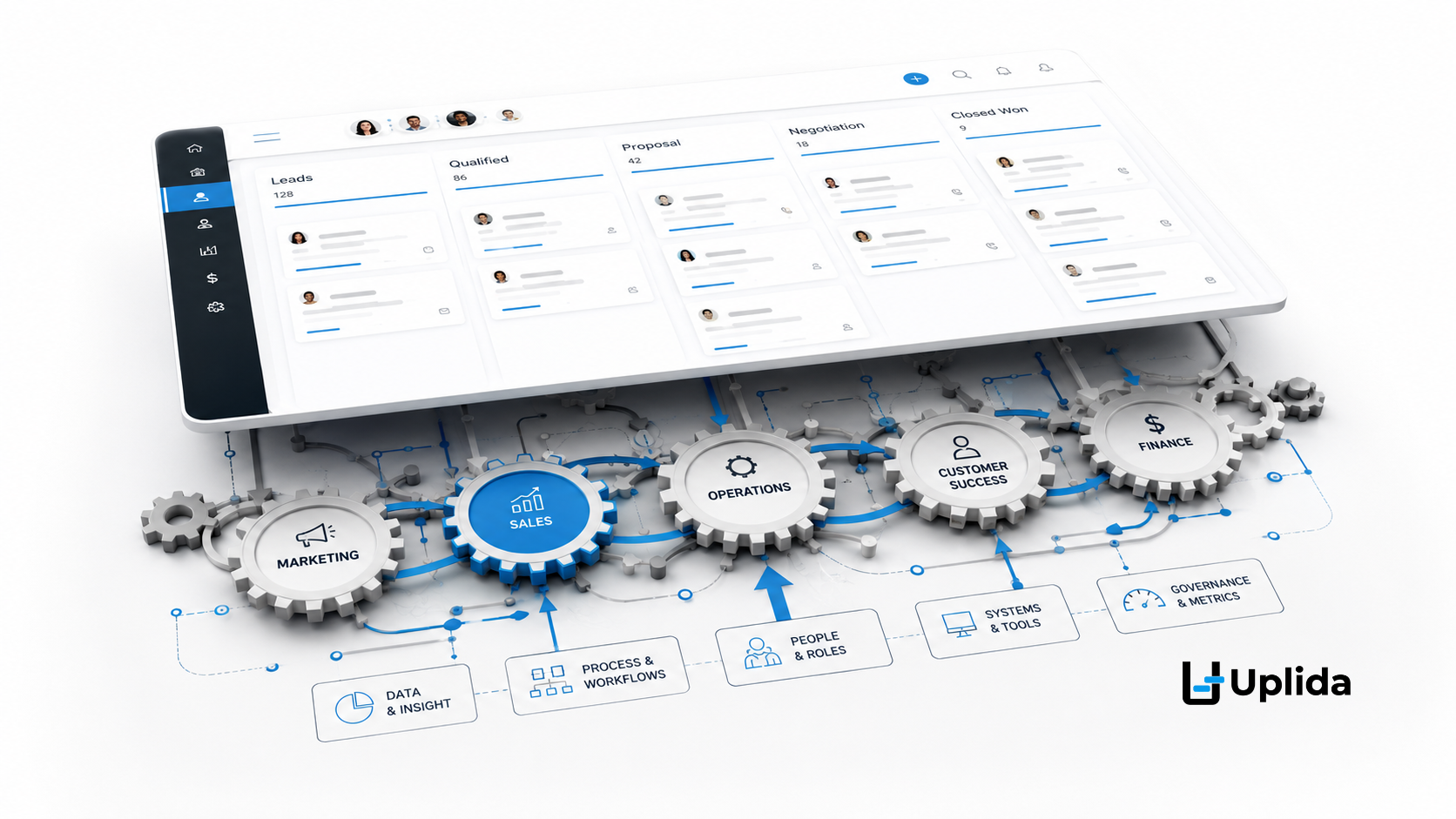
A CRM is often treated as the place where sales activity gets recorded. In reality, it is where a company’s operating model becomes visible.
When the CRM is messy, leaders usually see a technology problem. The fields are inconsistent. The pipeline is unreliable. The data is incomplete. The team is not updating records. Forecasts are weak. Customer handoffs are unclear. Reporting takes too long.
Those symptoms matter. They are rarely the root issue.
More often, CRM problems reveal that the business has not clearly defined how work should move across marketing, sales, customer success, operations, finance, and leadership. The CRM becomes the place where unclear ownership, inconsistent process, weak operating cadence, and fragmented accountability show up in the data.
This distinction matters because many companies try to fix CRM issues by changing the platform, adding fields, cleaning records, or increasing training. Those actions may help. They will not solve the bigger problem if the company has not addressed the operating model underneath.
The central thesis is simple: most CRM problems are operating model problems. The software reflects how the business runs. If the operating model is unclear, the CRM will be unclear too.
1. CRM breakdowns usually start before anyone logs into the system
A CRM does not create alignment. It captures the presence or absence of it.
Consider a growing B2B company with a strong sales team, a capable service team, and a founder-led culture of responsiveness. Early growth may happen through relationships, urgency, and institutional knowledge. People know what to do because they are close to the work and close to each other.
Then the company grows.
More leads come in. Sales cycles get more complex. Multiple stakeholders are involved. Customer expectations increase. Service delivery requires coordination. Finance needs cleaner forecasting. Leadership wants visibility. Marketing wants attribution. Customer teams need context before onboarding. Operations needs to know what has been promised.
At that stage, informal coordination starts to break.
The CRM becomes frustrating because it is being asked to carry operational weight the business has not designed for. Sales may define stages one way. Leadership may interpret them another way. Customer success may receive accounts without the information needed to deliver well. Finance may question forecast accuracy because deal probability is based more on optimism than shared criteria.
The issue is not that the team failed to “use the CRM.” The issue is that the company has not fully defined how revenue work should move through the business.
A CRM works best when it reflects a clear commercial operating model:
Who owns each stage of the customer journey
What information is required at each handoff
Which actions trigger movement from one stage to another
How teams define qualified opportunities, committed revenue, at-risk accounts, and expansion potential
What leadership reviews weekly, monthly, and quarterly
Which metrics are used to make decisions
Without that clarity, the CRM becomes a shared database with competing interpretations.
2. Bad CRM data is usually a decision-rights problem
Leaders often describe CRM data as “dirty.” That word is convenient, but it can hide the real issue.
Bad CRM data frequently comes from unclear decision rights. People do not know which information matters, who is responsible for maintaining it, when it must be updated, or how it will be used.
For example, a sales leader may want accurate next steps. A CEO may care about forecast confidence. Marketing may need source attribution. Customer success may need onboarding details. Finance may need contract timing. Operations may need delivery requirements.
All of these needs are valid. The problem emerges when each function adds its own requirements without a shared operating logic. The CRM becomes crowded with fields, inconsistent definitions, and reports that serve different audiences without a common structure.
Then the organization blames the users.
The better question is: has the company made it clear what data is operationally necessary?
Useful CRM data has a job. It should help the business make decisions, serve customers, allocate resources, forecast revenue, improve conversion, reduce risk, and understand where work is stuck.
If a field does not support a decision or workflow, it is likely noise. If a field supports an important decision but no one owns it, it will become unreliable. If a field means different things to different teams, it will create false confidence.
This is where operating model design becomes essential. A company needs to define the minimum viable data structure required to run the business well. That includes common definitions, clear ownership, update expectations, and leadership discipline around using the data.
The discipline matters. Teams pay attention to what leadership uses. If executives ask for CRM hygiene but make decisions from side spreadsheets, private updates, and anecdotal conversations, the CRM loses authority. If leadership uses CRM data consistently in pipeline reviews, customer reviews, forecasting discussions, and operational planning, the system becomes part of how the company runs.
CRM adoption follows operating discipline.
3. Pipeline visibility depends on process clarity, not reporting volume
Many executives want better CRM reporting. They want clearer dashboards, cleaner pipeline views, and more accurate forecasts.
The instinct is understandable. Visibility matters. But reporting cannot compensate for a poorly defined revenue process.
A dashboard can show that deals are stuck. It cannot explain whether the sales stages are meaningful. A forecast can show expected revenue. It cannot determine whether opportunity probability is based on consistent criteria. A pipeline report can show activity. It cannot reveal whether the right work is happening at the right time.
Good pipeline visibility requires the business to define how revenue actually progresses.
That means the company needs more than stage names. It needs stage standards. What must be true for an opportunity to move forward? What buyer signals matter? What internal approvals are needed? What risks should be documented? What information must be captured before a proposal goes out? When should operations or service delivery be consulted? When does finance need visibility into pricing, timing, or contract structure?
These questions are operating model questions.
A CRM can enforce process, but it should not be used as a substitute for process design. When companies skip that work, they often end up with sales stages that describe internal optimism rather than buyer reality.
This creates several downstream problems.
Leadership overestimates revenue.
Operations gets surprised.
Customer teams inherit vague commitments.
Finance questions the forecast.
Marketing cannot see what is converting.
Sales managers coach from incomplete information.
The company may have activity. It may even have growth. It does not have dependable operating visibility.
The stronger approach is to design the revenue process first, then configure the CRM to support it. The system should make the operating model easier to follow. It should not ask employees to guess what the operating model is.
4. Customer experience suffers when CRM design stops at the sale
Many CRM implementations are built around sales management. That is understandable. The CRM is often purchased to manage leads, opportunities, pipeline, and revenue.
For growing B2B companies, that view is too narrow.
The customer does not experience the business in departmental stages. The customer experiences one continuous relationship. They move from awareness to conversation to evaluation to purchase to onboarding to service to renewal or expansion. Every handoff shapes their confidence.
When the CRM is designed only for sales visibility, the post-sale experience often depends on informal transfer of knowledge. Customer success, operations, service, or account management may receive partial context. What was promised? What problem is the customer trying to solve? Who are the key stakeholders? What risks surfaced during the sales cycle? What does success look like in the first 30, 60, or 90 days?
If that information lives in call notes, inboxes, Slack threads, or someone’s memory, the business has created avoidable risk.
This is where CRM problems become customer experience problems.
A weak handoff can slow onboarding, create rework, frustrate the customer, and damage trust early in the relationship. The team may work hard to recover, but the issue was designed into the system from the beginning.
A stronger CRM operating model connects the full customer journey. It defines what must transfer from one team to another and when. It makes customer commitments visible. It gives service teams the context they need before the customer has to repeat themselves. It allows leaders to see where experience breaks down before churn or dissatisfaction appears in the numbers.
Customer experience is not only shaped by frontline behavior. It is shaped by the operating system behind the frontline.
5. The CRM should reduce complexity, not institutionalize it
As companies scale, complexity increases naturally. More customers. More segments. More products. More channels. More people involved in decisions. More internal dependencies.
The answer is not to add more process for its own sake. The answer is to create enough structure to make the business easier to run.
A well-designed CRM should reduce ambiguity. It should clarify what matters, who owns it, and what happens next. It should make the company faster, not heavier. It should help teams see the same reality without requiring constant manual reconciliation.
That requires restraint.
Many CRM systems become complicated because companies try to capture everything. Every possible field. Every stakeholder preference. Every hypothetical report. Every exception.
The result is a system that feels administrative rather than operational. Teams update it because they are required to, not because it helps them do better work.
The better test is practical: does the CRM help the company move customers, revenue, and work through the business with greater clarity?
If the answer is no, the issue may not be the platform. The issue may be that the company has automated or documented confusion.
Leaders should ask sharper questions before changing tools or redesigning dashboards:
Do we have a clearly defined customer journey from lead to renewal?
Do our teams agree on what each pipeline stage means?
Do we know who owns each handoff?
Are we collecting data that supports decisions, or data that satisfies curiosity?
Are CRM expectations reinforced through leadership cadence?
Can customer-facing teams see the context they need to serve well?
Does our CRM reflect how we want the business to operate, or how it has informally evolved?
These questions move the conversation from CRM administration to operating design.
Why this matters now
The pressure on companies is changing.
Growth is harder to earn. Buyers are more cautious. Sales cycles are less linear. Customer expectations are higher. Teams are being asked to do more without adding unnecessary headcount. Leaders want the benefits of automation and AI, but many organizations still lack the process clarity required to use those tools well.
In that environment, CRM discipline becomes more important, not less.
AI can summarize calls, enrich records, trigger workflows, and surface insights. Automation can reduce manual work. Dashboards can improve visibility. None of those capabilities will create clarity where the operating model is vague.
In fact, automation can make poor process move faster. AI can generate outputs from weak inputs. Reporting can create the appearance of control without improving the quality of decisions.
This is why companies need to treat CRM improvement as a business design exercise, not a software cleanup project.
The CRM should become a practical expression of how the company grows, serves, retains, and expands customer relationships. It should connect strategy to daily execution. It should show leaders where work is moving, where it is stuck, and where the customer experience is at risk.
That kind of CRM does not happen by accident. It requires operational clarity.
Conclusion
CRM problems are easy to see because they show up in fields, reports, dashboards, and missed updates. Operating model problems are harder to see because they live in assumptions, handoffs, habits, and unclear ownership.
That is why companies often address the visible issue first. They clean the data. They retrain the team. They rebuild the dashboard. They consider switching platforms.
Sometimes those actions are necessary. They are not sufficient.
A CRM can only be as clear as the business system behind it. When the operating model is unclear, the CRM becomes a mirror of confusion. When the operating model is clear, the CRM becomes a tool for alignment, visibility, and scale.
The companies that get this right will stop asking, “Why won’t our team use the CRM?”
They will ask a better question:
“Have we designed the business clearly enough for the CRM to reflect how we actually need to operate?”
That is where the real work begins.
